
How Do Red and Infrared Light Work for Humans and Pets? Understanding the Functions of This Portable Therapy Device
- winni
- April 04, 2026
- 183
- 0
- 0
I. Core Mechanism: Photobiomodulation
This device utilizes Low-Level Laser Therapy (LLLT). Its core mechanism is known as "photostimulation." Specifically, when laser energy of particular wavelengths penetrates the skin and enters body tissues, it triggers a series of biochemical reactions that yield the following positive effects:
Promotes Endorphin Release: Endorphins are the body's natural painkillers. Laser application can stimulate the body to release more endorphins, thereby helping to alleviate localized pain.
Accelerates Tissue Repair and Reduces Inflammation: Laser energy can speed up the repair process of damaged tissues while promoting the drainage of excess fluid from swollen areas, helping to reduce inflammatory responses and edema.
Activates Cell Regeneration: By stimulating the activity of injured cells, it enables them to repair and regenerate at an accelerated rate, thus advancing the healing process.
The entire treatment process is non-thermal, non-invasive, and pain-free.
II. Dual-Wavelength Synergy: Coverage from Surface to Depth
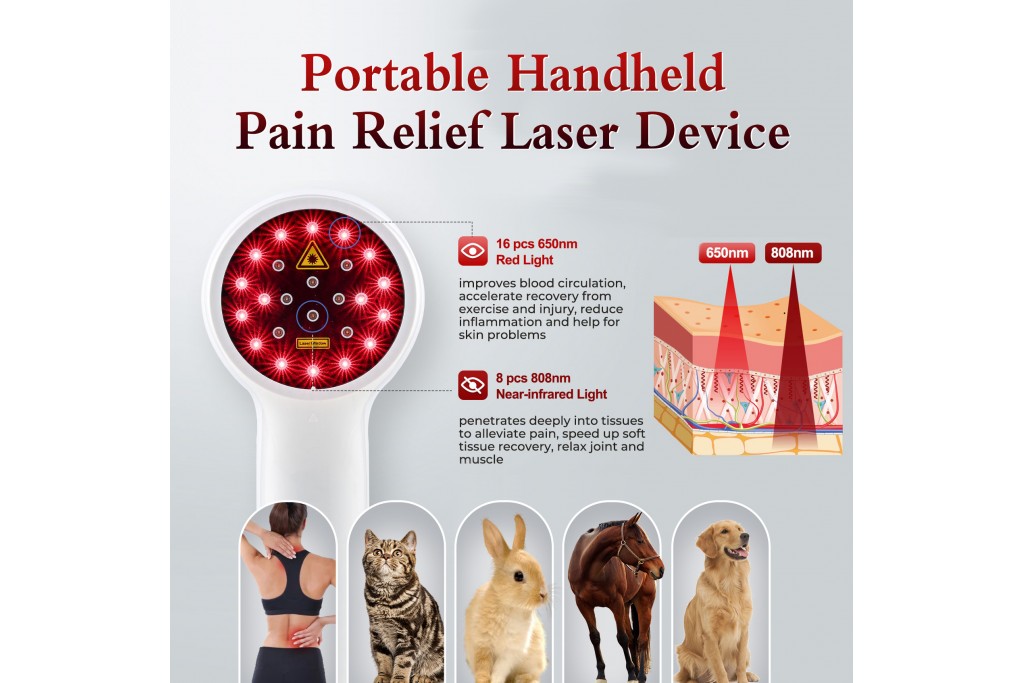
The device integrates two different wavelengths of laser diodes, each targeting tissues at different depths to achieve synergistic therapy from superficial to deep layers.
1. 650nm Red Laser Light – Surface Care
The 650nm wavelength falls within the visible red light spectrum and primarily acts on the skin and superficial soft tissues. Its specific functions include:
Enhances Blood Circulation: Promotes local blood flow in the treatment area, delivering more nutrients for tissue repair.
Alleviates Skin Inflammation and Redness: Soothes inflammatory reactions in the epidermal layers.
Supports Wound Healing: Applicable during the recovery phase of post-surgical wounds and soft tissue injuries.
Stimulates Acupuncture Points: Can be used for acupoint irradiation.
2. 808nm Near-Infrared Laser Light – Deep Penetration
The 808nm wavelength is invisible to the naked eye. Its characteristic is deeper penetration, capable of reaching muscles, tendons, and joints. It primarily addresses the following scenarios:
Chronic Joint Pain: Such as knee arthritis, rheumatoid arthritis, and shoulder periarthritis.
Spine-Related Issues: Such as cervical spondylosis and discomfort radiating from herniated discs.
Deep Muscles and Soft Tissues: Targets deep pain points like muscle knots, tendonitis, and bursitis.
III. Reference Applications for Humans
Based on different symptoms, the device can be set with corresponding treatment durations and working modes. Below are some applicable scenarios for humans and suggested parameters:
Musculoskeletal Pain:
Neck/Shoulder Pain: Pulsed Mode, 10–15 minutes
Upper/Lower Back Pain: Pulsed Mode, 15–20 minutes
Wrist, Bone, Joint Discomfort: Pulsed Mode, 15–20 minutes
Heel Spur: Pulsed Mode, 15 minutes
Tennis Elbow: Pulsed Mode, 20 minutes
Plantar Fasciitis: Pulsed Mode, 20 minutes
Achilles Tendinitis: Pulsed Mode, 10–15 minutes
Sciatica: Pulsed Mode, 15–20 minutes
Carpal Tunnel Syndrome: Pulsed Mode, 15–20 minutes
Myofascial Pain Syndrome: Pulsed Mode, 15–20 minutes
Inflammation and Tissue Injuries:
Inflammation: Pulsed Mode, 15 minutes
Bursitis/Tendonitis: Pulsed Mode, 15 minutes
Sports Injuries: Pulsed Mode, 10–15 minutes
Burns: Pulsed Mode, 10–15 minutes
Wound Healing: Pulsed Mode, 10–15 minutes
Other Applications:
Nerve Regeneration Support: Continuous Mode, 15 minutes
Gum and Jaw Problems, Acne, Herpes Simplex: Use can be referenced based on actual conditions.
The above scenarios are recommended to be performed at 100% Output Power.
IV. Reference Applications for Pets
This device is also suitable for auxiliary care for household pets such as dogs and cats. Since pet fur may block some light, the laser head should be placed as close to the skin as possible during use. Areas with sparse or no hair typically show faster results.
Applicable symptoms include:
Pain Relief: Pulsed Mode, 15 minutes
Open Wounds and Injuries: Pulsed Mode, 20 minutes
Acute & Chronic Otitis: Pulsed Mode, 15 minutes
Degenerative Disc Disease: Pulsed Mode, 15–20 minutes
Hip Dysplasia: Pulsed Mode, 20 minutes
Degenerative Joint Disease: Pulsed Mode, 15–20 minutes
Hot Spots/Dermatological Disorders: Pulsed Mode, 20 minutes
Arthritis and Lick Granulomas: Pulsed Mode, 15 minutes
Anal Gland Issues: Pulsed Mode, 20 minutes
Musculoskeletal Pain: Pulsed Mode, 20 minutes
Paw Swelling: Pulsed Mode, 15–20 minutes
Similarly, treatment for pets is recommended at 100% Output Power.
V. Expected Timeline for Results
The cumulative nature of photostimulation is key to achieving optimal outcomes. After a single session, some users may feel reduced discomfort or soreness, but consistent and regular use over multiple sessions is required for more stable improvement.
Suggested Usage: 1–2 times daily, approximately 20 minutes per session (adjusted based on the specific area). Noticeable improvement is typically observed after 4 weeks of consistent use.
VI. Differences Between the Two Working Modes
The device offers two laser output modes to suit different needs:
Continuous Mode: The laser emits steadily without interruption. Suitable for scenarios requiring constant energy stimulation, such as auxiliary support for nerve repair.
Pulsed Mode (Frequency 5Hz): The laser emits intermittently at a rate of 5 times per second. Pulsed Mode is recommended for most pain and inflammation issues, except for nerve regeneration scenarios.
VII. Safety and Contraindications
To ensure safe operation, the following conditions should avoid using this device:
Pregnancy, breastfeeding, or planning pregnancy
Presence of pacemakers or other implanted electronic devices
Use of photosensitizing medications
Photosensitive conditions (e.g., lupus, photosensitive dermatitis)
Coagulation disorders or use of blood-thinning medications
Under 14 years of age
Malignant skin lesions or suspected skin cancer
Undergoing immunosuppressive therapy
Diabetes
Diagnosed thyroid condition
History of epilepsy
Bacterial infection
Protective glasses must be worn during operation. Do not look directly into the laser beam or aim it at eyes.
Conclusion
Through the synergistic action of 650nm and 808nm dual wavelengths, this portable red and infrared therapy device covers multiple tissue layers from the epidermis to deep joints, offering a non-pharmacological, non-invasive auxiliary option for pain relief, inflammation reduction, and tissue repair. Whether addressing common neck, shoulder, back, and leg discomfort in humans, or arthritis and wound healing in pets, it holds certain applicable reference value.