
7 Chakras Explained: How Bioresonance Chakra Assessment Can Support Energy Healing Practitioners
- winni
- September 09, 2026
- 6
- 0
- 0

From Intuitive Chakra Work to a More Trackable Energy Assessment
If you work with chakras, you already know that energy healing is highly personal.
Many practitioners assess chakra balance through intuitive sensing, hands-on observation, pendulum work, muscle testing, client feedback, or years of accumulated experience. These approaches can be valuable parts of an energy healing practice.
But there is one common challenge:
How do you document something as subtle and personal as an energy experience?
Clients may ask:
- Which chakra needs the most attention?
- Has my energy changed since the last session?
- What changed after the healing session?
- Can we track my progress over several sessions?
- Why does one chakra appear different from another?
Subjective feedback can provide important insights, but it can be difficult to record and compare consistently.
This is where bioresonance chakra assessment can provide an additional reference point.
A bioresonance-based chakra scan can generate reference data for the seven major chakras, from S1 to S7, creating a visual format that practitioners can use alongside their existing assessment methods.
It is not intended to replace intuition, practitioner experience, or established energy healing techniques. Instead, it can add another layer of reference to the client journey.
Important Disclaimer: Chakra and bioresonance assessments are intended for complementary wellness and energy-work reference only. They are not medical diagnostic tools and should not be used to diagnose, treat, cure, or prevent disease or replace professional medical care.
What Are the 7 Chakras?
In traditional chakra systems, the seven primary chakras are commonly described as energy centers located along the central axis of the body.
Each chakra is associated with different themes such as grounding, creativity, personal power, emotional connection, communication, intuition, and higher awareness.
For energy healing practitioners, understanding the relationship between the seven chakras can provide a framework for exploring a client's overall energetic experience rather than focusing on a single area in isolation.
Let's look at the S1–S7 chakra system commonly used in chakra-based energy assessment.
S1 – Root Chakra
Location: Base of the spine
Key themes: Grounding, stability, security, survival, connection to the physical world
The Root Chakra is traditionally associated with feelings of safety, stability, grounding, and belonging.
From an energy-work perspective, clients may describe experiences such as feeling unsettled, disconnected, fearful, or unable to feel grounded.
Energy healing focus: Grounding practices, stability, relaxation, body awareness, and creating a stronger sense of safety.
S2 – Sacral Chakra
Location: Lower abdomen
Key themes: Creativity, emotional flow, pleasure, vitality, relationships
The Sacral Chakra is traditionally connected with emotional expression, creativity, enjoyment, and the ability to experience and move through emotions.
An imbalance in this area may be explored in relation to emotional suppression, lack of vitality, creative blocks, or difficulty enjoying everyday experiences.
Energy healing focus: Emotional release, creative expression, relaxation, and reconnecting with healthy emotional flow.
S3 – Solar Plexus Chakra
Location: Upper abdomen
Key themes: Personal power, confidence, motivation, willpower, self-expression
The Solar Plexus Chakra is often associated with confidence, self-esteem, personal boundaries, and the ability to take action.
Clients may explore this chakra when they experience self-doubt, difficulty setting boundaries, or a feeling of being disconnected from their personal sense of power.
Energy healing focus: Self-awareness, confidence, personal boundaries, and reconnecting with inner motivation.
S4 – Heart Chakra
Location: Center of the chest
Key themes: Love, compassion, connection, acceptance, relationships
The Heart Chakra represents emotional connection, compassion, acceptance, and interpersonal relationships within many traditional chakra systems.
During energy healing sessions, practitioners may focus on this area when clients describe emotional closure, difficulty trusting others, or challenges with self-acceptance.
Energy healing focus: Self-compassion, emotional openness, acceptance, and healthy connection.
S5 – Throat Chakra
Location: Throat area
Key themes: Communication, authenticity, self-expression, speaking one's truth
The Throat Chakra is traditionally associated with communication and authentic self-expression.
Clients may explore this area when they feel unable to express their thoughts, emotions, needs, or boundaries openly.
Energy healing focus: Communication, authentic expression, confidence in speaking, and emotional openness.
S6 – Third Eye Chakra
Location: Between the eyebrows
Key themes: Intuition, awareness, insight, perception, inner reflection
The Third Eye Chakra is commonly associated with intuition, perception, inner awareness, and reflection.
In energy work, practitioners may explore this chakra when clients describe mental confusion, difficulty trusting their intuition, or challenges with gaining clarity.
Energy healing focus: Mindfulness, reflection, meditation, awareness, and intuitive exploration.
S7 – Crown Chakra
Location: Top of the head
Key themes: Higher awareness, consciousness, spirituality, connection, inner stillness
The Crown Chakra is traditionally associated with higher consciousness, spiritual awareness, meditation, and a sense of connection beyond the physical self.
Practitioners may incorporate meditation and contemplative practices when working with this aspect of the chakra system.
Energy healing focus: Meditation, stillness, mindfulness, spiritual reflection, and expanded awareness.
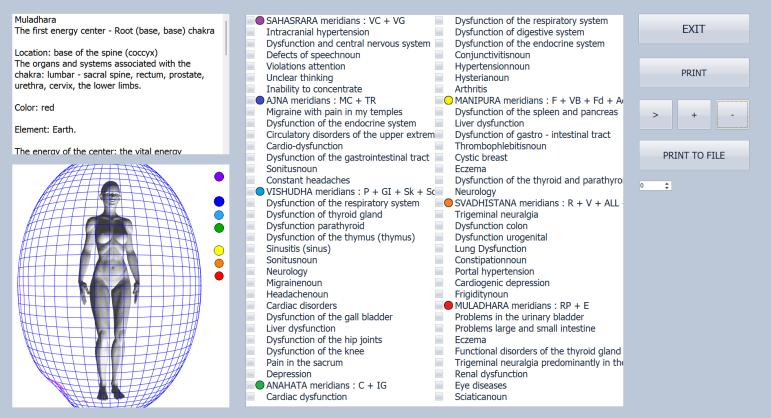
Why Look at All 7 Chakras Instead of One?
One of the most useful concepts in chakra-based energy work is interconnection.
Rather than viewing each chakra as an isolated point, many energy healing traditions consider the seven chakras as part of a connected system.
For example, a client may be experiencing challenges around communication while also exploring emotional expression or personal confidence.
Looking at the broader S1–S7 picture can therefore provide a more complete framework for a session.
A chakra assessment does not determine what a client should experience. Instead, it can give the practitioner another reference point for starting a conversation and exploring the client's subjective experience.
How Does Bioresonance Chakra Assessment Fit Into an Energy Healing Session?
A bioresonance chakra scan can be incorporated into an existing energy healing workflow without replacing the practitioner's preferred methods.
The basic idea is simple:
Assess → Explore → Work → Reassess → Track
This can make the energy healing process easier to document and discuss with clients.
If you would like to learn more about bioresonance chakra assessment, S1–S7 chakra analysis, or how it can be integrated into an energy healing practice, feel free to contact us on WhatsApp.
WhatsApp: +86 19557764278
We’re happy to provide more information and answer your questions.
Bioresonance Chakra Assessment: What Does It Add for Energy Healers?
For an energy healing practitioner, the value of chakra assessment is not simply the scan itself.
It is how the information can support the overall client experience.
A More Visual Way to Discuss Energy
Energy concepts can be difficult for new clients to understand because they are often abstract.
A seven-chakra visualization gives practitioners something concrete to discuss during a consultation.
Instead of relying entirely on verbal explanations, the practitioner can use the S1–S7 reference chart as a visual conversation tool.
Better Session Documentation
Client notes are an important part of long-term practitioner work.
Adding chakra assessment results can provide another type of session record that can be compared over time.
This can be particularly useful for practitioners who work with clients through multiple sessions rather than one-time appointments.
A More Structured Client Journey
A simple pre-session and post-session assessment framework can create a clearer service structure:
Initial Assessment → Energy Session → Post-Session Review → Follow-Up
This can make the client journey easier to explain and organize.
Works Alongside Different Energy Healing Modalities
Chakra assessment does not have to belong to a single healing tradition.
Practitioners may integrate it into different holistic approaches, including:
Reiki + Chakra Assessment
Crystal Healing + Chakra Assessment
Sound Healing + Chakra Assessment
Meditation + Chakra Assessment
Aromatherapy + Chakra Assessment
Yoga + Chakra Assessment
The assessment simply provides another reference layer that can be incorporated into an existing practice.
From Intuition to Documentation — Without Losing the Human Element
There is an important distinction between quantifying a reference and quantifying the entire healing experience.
A numerical or visual reference cannot fully describe how a person feels.
It cannot replace a practitioner's ability to listen.
It cannot replace intuition.
And it cannot replace the relationship between practitioner and client.
What it can do is provide something that traditional intuitive assessment often lacks:
a visual reference that can be recorded, compared, and discussed.
That makes it particularly interesting for practitioners who want to combine traditional energy work with modern assessment technology.
How to Use Chakra Assessment Responsibly
Because chakra systems belong primarily to traditional, spiritual, and complementary wellness practices, assessment results should be communicated carefully.
Avoid presenting a chakra reading as:
- A medical diagnosis
- A clinical test
- Proof of disease
- Proof that a treatment has cured a condition
- A replacement for professional healthcare
Instead, frame the results as complementary wellness and energy-work references.
The most useful approach is to combine assessment data with:
Client feedback + practitioner observation + session history + personal wellness goals
This keeps the human experience at the center.
The Future of Energy Healing: Technology Meets Traditional Practice
Energy healing has traditionally depended heavily on practitioner experience, intuition, observation, and communication.
Technology does not necessarily have to replace those elements.
It can complement them.
A bioresonance chakra assessment provides a way to visualize the seven-chakra system, create reference records, compare sessions, and support conversations with clients.
For practitioners, the real value may not be in having "more data."
It may be in having another way to understand and communicate the client journey.
From the first chakra assessment to long-term follow-up, the combination of traditional energy work and visual reference technology can create a more structured approach to documenting the experience.
Final Thoughts
The heart of chakra-based energy work remains the practitioner: their presence, listening skills, experience, intuition, and relationship with the client.
A bioresonance chakra scan does not need to replace those qualities.
Instead, it can serve as an additional assessment layer — helping practitioners visualize S1–S7 chakra reference patterns, document sessions, compare changes over time, and create a clearer framework for client conversations.
For energy healers and holistic practitioners looking to make their client workflow more structured while keeping the personal side of energy work intact, bioresonance chakra assessment can be explored as a complementary tool for chakra-based wellness practices.
Disclaimer: Chakra assessment and bioresonance technology described in this article are intended for complementary wellness and energy-work reference purposes only. They are not intended to diagnose, treat, cure, or prevent any disease or medical condition and should not replace professional medical advice, diagnosis, or treatment.