
Low‑Intensity Millimeter‑Wave Therapy: The Weird, Under‑Rated Electromagnetic Hack For Pain & Healing
- winni
- September 09, 2026
- 3
- 0
- 0
Think millimeter waves, and your brain may jump straight to 5G networks, radar systems or futuristic telecommunications equipment.
But millimeter-wave technology has another, much quieter application.
Low-intensity millimeter-wave therapy, often called MWT, millimeter-wave therapy, or EHF therapy (extremely high-frequency therapy), uses very low levels of electromagnetic energy for complementary health and physiotherapy applications.
Unlike conventional heat-based treatments, low-intensity MWT is designed to produce non-thermal biological effects rather than simply warming tissue. Research over several decades has explored its potential applications in pain management, wound recovery and other physiological responses.
So how does millimeter-wave therapy work, what does the research actually show, and where does it fit into modern wellness and physiotherapy?
Let's take a closer look.
What Is Low-Intensity Millimeter-Wave Therapy?
Millimeter waves occupy a specific part of the electromagnetic spectrum, generally associated with wavelengths from about 1 to 10 mm and frequencies around 30–300 GHz.
In therapeutic applications, the important factor is not simply the frequency. It is also the very low intensity of the electromagnetic exposure.
Low-intensity millimeter-wave therapy is designed to operate at energy levels that produce little or no noticeable heating of the treated area. This makes MWT fundamentally different from conventional heat therapy, where the therapeutic effect is largely associated with increased tissue temperature.
Millimeter-wave radiation is also non-ionizing radiation. Its photon energy is not sufficient to directly break chemical bonds in the way ionizing radiation can.
How Deep Do Millimeter Waves Penetrate?
One of the most interesting characteristics of low-intensity millimeter-wave therapy is its relatively shallow penetration into biological tissue.
Because millimeter waves are strongly absorbed by water-rich tissue, much of the electromagnetic energy is deposited close to the skin surface.
That raises an obvious question:
If millimeter waves mainly interact with superficial tissue, how could they produce effects beyond the treatment area?
This question has become one of the most interesting areas of MWT research.
Researchers have described what is sometimes called a remote or distal biological effect, in which physiological changes are observed beyond the immediate area exposed to millimeter-wave radiation.
The exact mechanisms behind these effects remain under investigation.
How Might Millimeter-Wave Therapy Work?
The biological mechanism of low-intensity millimeter-wave therapy has not been completely established.
Several mechanisms have been proposed, including interactions involving cell membranes, signaling pathways, nervous-system responses, microcirculation and other biological processes.
Some researchers have also proposed that biological structures may respond to specific electromagnetic frequency patterns through resonance-like interactions.
However, it is important to distinguish between a proposed mechanism and a scientifically established explanation.
Rather than saying that millimeter waves simply “retune” cells, current research is better understood as investigating whether low-intensity electromagnetic signals can influence biological signaling and physiological responses under specific conditions.
In other words, MWT is not intended to “zap” tissue or generate a strong thermal effect. The research question is whether very low-intensity electromagnetic exposure can trigger measurable biological responses.
What Does Research Say About Low-Intensity Millimeter-Wave Therapy?
Research into low-intensity millimeter-wave therapy has been ongoing for decades, particularly in Eastern Europe and parts of Asia.
A systematic review published in 2006 examined clinical research involving low-intensity millimeter-wave therapy, including randomized controlled trials investigating pain and wound-related applications.
The findings were interesting, but the researchers also highlighted limitations in the available evidence.
This is an important distinction:
Millimeter-wave therapy is an area of ongoing research, not a proven cure-all.
Pain Relief
One of the most frequently investigated applications of MWT is pain management.
Research has explored millimeter-wave therapy in connection with several types of pain, including:
- Tension-type headaches
- Osteoarthritis-related discomfort
- Rheumatoid-related pain
- Neuropathic pain
- Musculoskeletal pain
- Post-surgical discomfort
Some studies have reported reductions in pain during or following millimeter-wave exposure.
Another unusual feature reported in some research is that treatment does not always have to be applied directly over the painful area. Certain protocols have investigated stimulation of specific skin regions or points located away from the site of discomfort.
This contributes to the ongoing interest in the remote or distal effects of millimeter-wave therapy.
Wound Recovery
Another area of research is wound healing and tissue recovery.
Some clinical studies have investigated whether low-intensity millimeter-wave exposure may support the recovery process following injury or surgery.
Research involving chronic wounds and diabetes-related ulcers has also attracted attention, although evidence quality and treatment protocols vary.
For people dealing with slow-healing wounds, MWT should be considered a complementary approach rather than a replacement for standard wound care.
Medical assessment, infection management, blood-glucose control and appropriate wound treatment remain essential.
Inflammation and Immune-Related Responses
Some studies have reported changes in inflammatory markers, lymphocyte activity and other physiological parameters following millimeter-wave exposure.
This has led researchers to investigate whether low-intensity MWT may influence certain aspects of the body's inflammatory and immune responses.
However, “immune modulation” is not the same as “boosting the immune system.”
The human immune system is highly complex, and changes in an individual biomarker do not automatically translate into improved health outcomes.
For this reason, claims about immune benefits should be interpreted carefully.
Support During Cancer Treatment
Millimeter-wave therapy has also been explored in some oncology-related research, particularly as a possible supportive approach for treatment-related symptoms or side effects.
This area requires especially careful interpretation.
MWT is not a cancer treatment and should never replace surgery, chemotherapy, radiation therapy, immunotherapy or other evidence-based cancer care.
Any use alongside cancer treatment should be discussed with an appropriately qualified healthcare professional.
Four Defining Features of Low-Intensity Millimeter-Wave Therapy
1. Non-Thermal Treatment
One of the defining characteristics of low-intensity millimeter-wave therapy is that its intended biological effects are not primarily based on heating tissue.
Unlike infrared heat therapy or traditional thermal physiotherapy, users may experience little or no noticeable temperature change during treatment.
Some people may notice mild sensations such as tingling or warmth, but the treatment is generally designed around low-intensity, non-thermal exposure.
2. Possible Remote or Distal Effects
The remote effect is one of the most distinctive and debated characteristics associated with MWT.
Some research has reported physiological responses outside the exact area exposed to millimeter waves.
Scientists have proposed several possible explanations involving neural, vascular and signaling pathways, but the precise mechanism remains an active research topic.
3. Repeated Sessions Are Common
Low-intensity millimeter-wave therapy is generally investigated as a course of repeated exposure rather than a one-time treatment.
For chronic discomfort or long-term wellness applications, treatment protocols may involve multiple sessions over a period of time.
The appropriate frequency and duration depend on the specific device, protocol and intended application.
There is currently no single universal MWT schedule that applies to every condition.
4. Generally Designed for Low-Intensity Exposure
Low-intensity MWT is fundamentally different from high-power electromagnetic applications.
Therapeutic devices are designed around controlled exposure parameters rather than strong energy delivery or tissue heating.
That said, low intensity does not automatically mean suitable for everyone. Device specifications, intended use, contraindications and professional guidance should always be considered.
Who Should Be Cautious With Millimeter-Wave Therapy?
Although low-intensity millimeter-wave therapy is generally designed as a gentle, non-thermal approach, certain people should seek professional guidance before using electromagnetic therapy.
Particular caution may be appropriate for people who:
- Have a pacemaker or other implanted electronic medical device
- Are pregnant
- Have a bleeding disorder or increased bleeding risk
- Have received an organ transplant
- Have an active or serious medical condition requiring treatment
- Are considering exposure near the eyes
Safety recommendations can vary depending on the specific millimeter-wave device and its operating parameters.
For that reason, always follow the manufacturer's safety instructions and seek professional medical advice when you have a medical condition or implanted device.
Can Millimeter-Wave Therapy Be Used at Home?
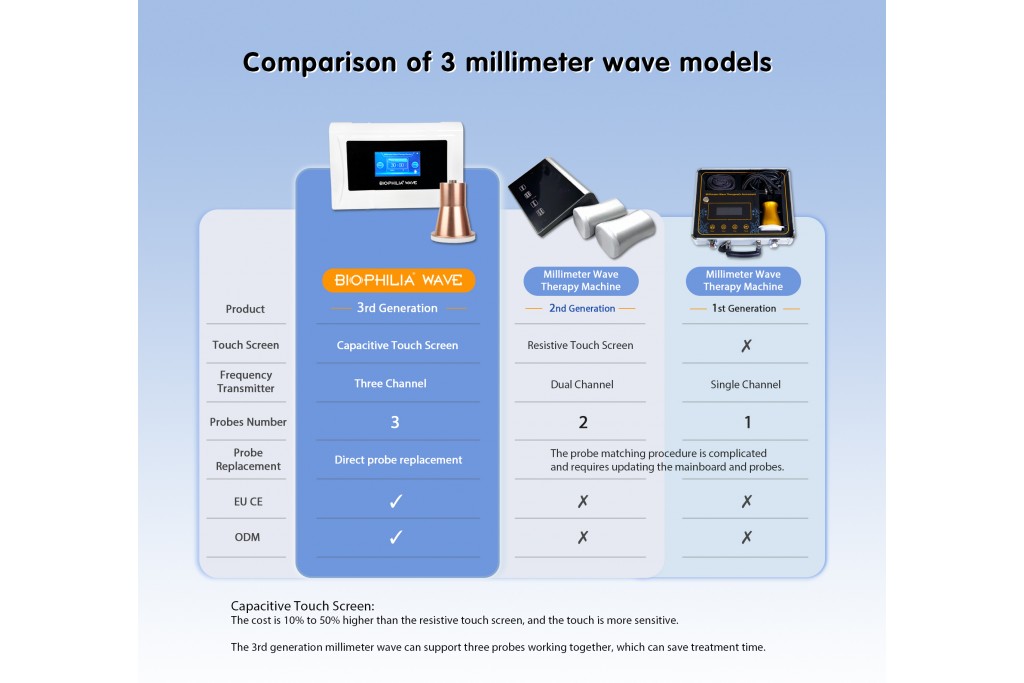
The development of portable electromagnetic therapy devices has made low-intensity millimeter-wave technology more accessible outside traditional clinical environments.
Home-use applications may focus on areas such as:
- Everyday wellness support
- Musculoskeletal comfort
- Relaxation and recovery
- Complementary pain management
- Ongoing wellness routines
However, home use does not mean that the technology should be treated as a replacement for medical care.
If you are experiencing persistent pain, unexplained symptoms, diabetes-related wounds or another diagnosed condition, professional evaluation should come first.
Where Does Millimeter-Wave Therapy Fit Into Modern Healthcare?
Today, low-intensity millimeter-wave therapy can be viewed within the broader category of complementary and supportive technologies.
Two common application environments include:
Physiotherapy and Wellness Clinics
Clinics may incorporate electromagnetic therapies into broader programs involving physical rehabilitation, pain management, mobility support and recovery.
MWT may be used alongside other approaches rather than as a standalone treatment.
Portable Wellness Devices
Portable millimeter-wave therapy devices are increasingly designed for convenient use outside clinical settings.
These products may appeal to people interested in non-drug, non-invasive and non-thermal approaches to everyday wellness.
The key point is simple:
MWT should complement appropriate healthcare, not compete with it.
It should not be used as a substitute for surgery, prescribed medication, insulin therapy, wound treatment or evidence-based cancer treatment.
What Are the Biggest Unanswered Questions?
Despite decades of research, low-intensity millimeter-wave therapy still has important scientific questions to answer.
Researchers continue to investigate:
- How superficial electromagnetic exposure may produce responses beyond the treated skin area
- Which frequencies and exposure parameters produce the most consistent biological responses
- How treatment protocols should differ for different applications
- Whether reported effects can be reproduced across larger and more diverse populations
- How much of the observed benefit comes from specific biological effects versus placebo and other contextual factors
- Which applications have enough high-quality clinical evidence to support routine use
These questions are exactly why continued research matters.
The interesting part of MWT is not that everything has already been proven. It is that there is enough research to justify continued investigation, while important uncertainties remain.
Disclaimer: This article is for educational and informational purposes only and does not constitute medical advice. Low-intensity millimeter-wave therapy should not replace professional medical diagnosis, prescribed medication, surgery, wound care, cancer treatment or other evidence-based healthcare. Individual responses may vary. If you have a medical condition, are pregnant, have an implanted electronic device, or are receiving medical treatment, consult an appropriately qualified healthcare professional before using electromagnetic therapy.